Wild West Pioneers City Layout and Building Range Guide
Every building has a range. That does not mean every building has to live inside the same one — the difference between local range and the warehouse network is what decides your town plan.
Quick Answer
Buildings draw from what is inside their own range, but the warehouse network carries resources further: warehouses with a road connection to the Town Hall can share with each other. That is what stops your town from having to be one tight cluster.
In a reply about the demo, Toplitz staff suggested one cluster for hunting, logging, butchering and a warehouse, then a separate cluster for tents, water, a food shop and another warehouse. Roads back to the Town Hall let those warehouses share goods. This is a useful example, not a required blueprint for every save.
Practically: keep each building inside range of the things it directly uses, put warehouses at the edge of each cluster, and connect every warehouse back to the Town Hall by road. Production and housing can then sit far apart.
On This Page
Why Your Town Feels Cramped
A new player builds a Hunter Cabin, then a Butcher, then somewhere for people to live, and everything has to touch. Move one building and something stops producing. The conclusion is that the whole settlement has to fit around a single range, and the town ends up as a knot of buildings with no room to be a town.
That happens because the range rule is the first rule you meet and it is a local one. What it does not tell you is that the game also has a second, longer-distance system sitting behind it — and that system is what you are supposed to design around.
Two Distances, Not One
- Local range is per building. A producer needs its inputs reachable; a shop needs the homes it serves nearby. This is the rule you cannot ignore.
- The warehouse network is town-wide. A warehouse connected by road to the Town Hall joins a shared pool, and other connected warehouses can draw from it.
Once you have both, the design question changes. You stop asking "how do I fit production and housing into one range?" and start asking "which warehouse does this building need to reach?" — which is a much smaller question with a much cheaper answer.
The warehouse side of this is covered in more detail on warehouse range explained, including the full production chain and where each warehouse goes.
Splitting Housing from Production
The plan that follows is two clusters joined by roads rather than one crowded centre:
- Put production where its raw materials are. The Hunter Cabin wants its hunting ground. There is no reason for housing to be near that, and every reason for it not to be.
- End the production cluster with a warehouse, and run a road from it to the Town Hall. That road is what lifts its resources out of the cluster.
- Put housing somewhere you chose, with its own warehouse, Food Shop and Tents, and its own road to the Town Hall.
- Keep the two roads connected end to end. Both warehouses must reach the Town Hall. A road that stops short leaves that cluster isolated again.
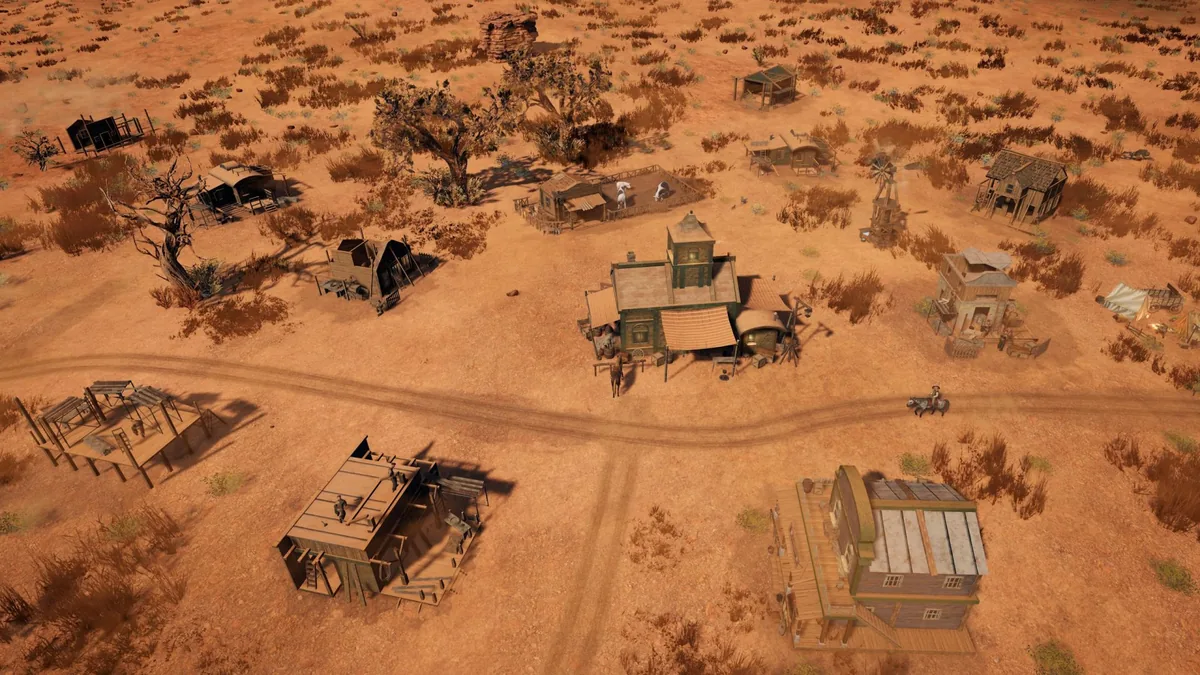
The Town Hall is the hub
It is easy to read "the warehouses share" as "warehouses share with each other directly". The connection that matters runs through the Town Hall: warehouse to Town Hall to warehouse. Plan your roads around the Town Hall as the centre, not around linking warehouses to one another in a chain.
Check a Broken Supply Route
If a shop or household lacks goods even though another cluster produces them, inspect the chain in this order. Each check tests a different link; do not move every building at once.
- Producer to local warehouse: confirm the producer has the input or wildlife it needs and that a warehouse is placed within the relevant local area. A disconnected or idle producer cannot fill the network.
- Warehouse to Town Hall: follow the road from the production warehouse all the way to the Town Hall. Repeat from the housing warehouse. The staff explanation requires both road connections.
- Housing warehouse to service: check that the Food Shop can draw from the housing cluster and that the Tents it serves are in the appropriate service and water areas.
The September 9 playtest hotfix added road-network highlighting in building view. If your version has that display, use it as a visual check; the announcement does not establish where the option appears in every later build. For the narrower warehouse rule, read our direct answer.
No Official Range Numbers
The developer has explained the warehouse sharing rule; nobody has published the distances around it. Specifically, there is no official figure for:
- how far a building's local range reaches,
- how long a road between a warehouse and the Town Hall can be,
- how far apart two warehouses can sit and still exchange resources.
Because of that this page describes proportions rather than measurements, and there is no number here to memorise. Where you have a choice, keep the distance short and the road unbroken — and treat any exact figure you see quoted elsewhere with suspicion, because it did not come from the developer.
If your town is already built and something is not working, the first thing to check is not a distance but a road: whether each warehouse actually has an unbroken route back to the Town Hall.